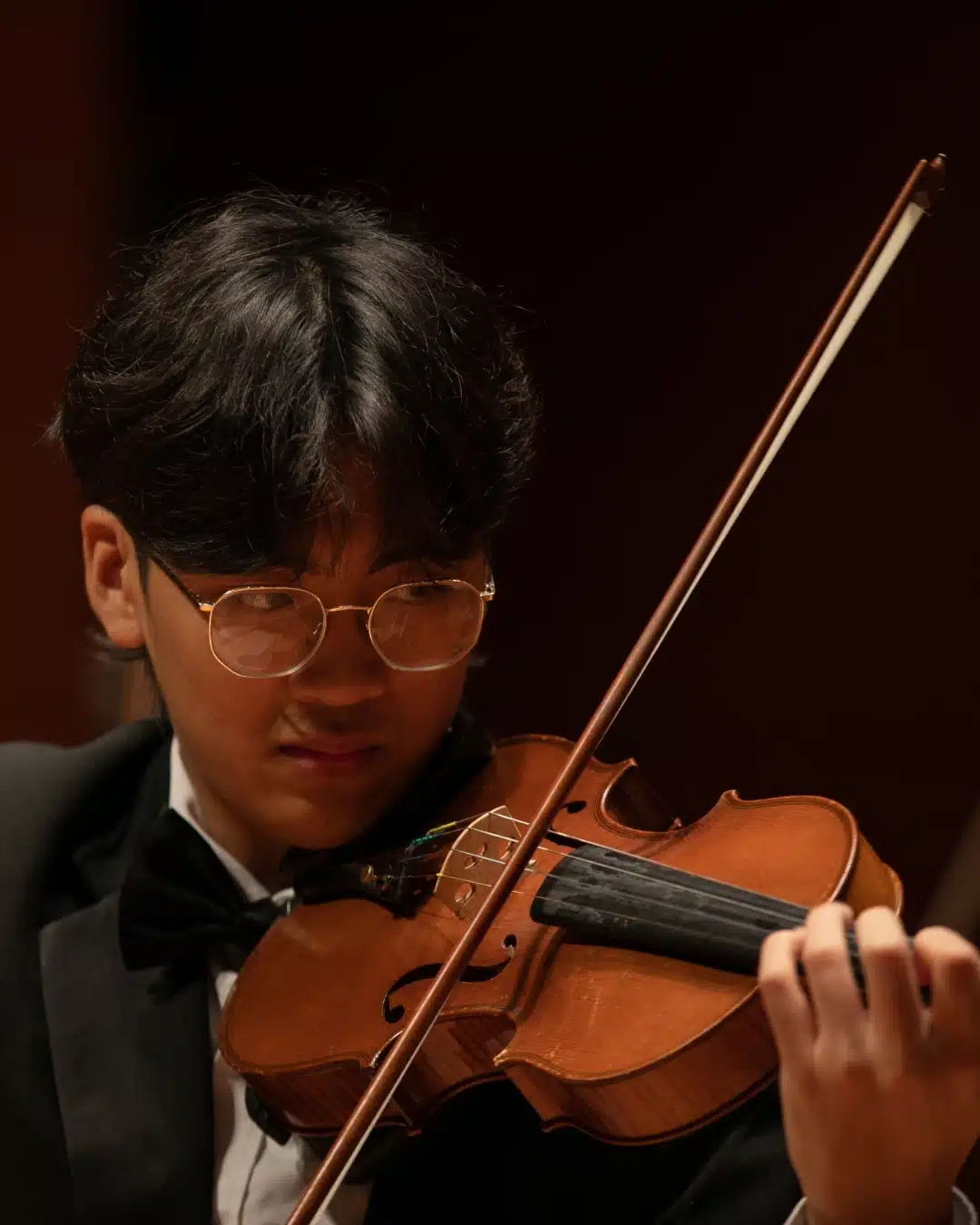
Every year, one deserving COS member is chosen through a competition to perform as soloist with the YSE in the annual COS Discovery Gala Concert, sharing the evening’s spotlight with some of world’s most established concert artists at a major concert venue in New York. Past guest artists, among many others, have included Emanuel Ax, Cecile Licad, Richard Stoltzman, Soovin Kim, Jaime Laredo, Sharon Robinson, and Yo-Yo Ma.
Holding to its principles of “Teaching Children the Language of Music”, this competition provides students an additional incentive to learn to work towards a standard of excellence, giving them the opportunity to grow immensely through its preparation. As the 11th Discovery Winner Pamela Sundelacruz describes the experience: “...everybody that enters would like to win. But there are no guarantees. While winning the competition can serve as motivation, I think each participant needs to have another aim — a focus on improving. These two ideas are related but not at all the same. Only one person wins the competition. However, every participant can succeed in improving — whether in technique, expression, or even performance. Once they are determined to improve, I have no doubt that there will be positive results.”
In 1984, Artistic Director Michael Dadap and Executive Director Dr. Yeou-Cheng Ma took over the directorship of COS with a vision to revive the orchestra through extensive music programs and performance opportunities. Their vision became a reality in less than five years, and their pursuit for developing a “whole musician” has attracted hundreds of children to the once eighteen-member orchestra. In 1993, as COS prepared for a concert with Yo-Yo Ma and the YSE, the Board suggested posting an ad in a major New York publication. Mr. Dadap instead convinced the Board to direct those funds toward scholarships and the launch of what would become the Discovery Competition.
Inspiration for the Discovery Competition came from the Avery Fisher career grant, which is given to artists after long observation of their dedication, performance, and focus. During the initial years of the Discovery Competition, the COS Directors nominated deserving members based on year-round performance, and a non-COS jury was invited to adjudicate. To keep pace with the growth of the Discovery Competition, the process has been refined over the years to allow every motivated student to participate, and to thus best fulfill the COS philosophy: to help children grow musically and mature as performers through this experience.
Application deadline · Saturday, September 19, 2026
Preliminary round · Friday, October 16, 2026
Semi-final round, if needed · Friday, October 23, 2026
Final round · Friday, October 30, 2026
Discovery Recital and Awards Ceremony · Saturday, November 7, 2026
The Senior winner performs as soloist with the Young Symphonic Ensemble at the Discovery Gala Concert. The Junior winner performs as featured soloist with the YSE in a season concert.
The Discovery Competition is open to all COS instrumentalists in good standing who have had at least one year of residency at COS
The Junior Division is open to applicants who have not reached their 15th birthday by April 2026. There are no age requirements for the Senior Division.
Students entering on an orchestral instrument must be enrolled in a COS orchestra.
Students who wish to compete on the piano or other non-orchestral instruments must be enrolled in Chamber Music on that instrument. They must also be enrolled in an orchestra on a secondary instrument.
Without exception, all candidates must be enrolled in a COS program with the instrument on which they are competing.
The Competition consists of two rounds (three, if necessary). Each round must be well-prepared to a high performance standard.
Musical artistry, mastery of the instrument, and presentation are the main factors of consideration.
Memorization of the “Concerto of Choice” is required in all rounds for Senior Division candidates. For Junior Division candidates, memorization is optional, but strongly preferred.
In any given round, the Jury reserves the right not to listen to a candidates repertoire in its entirety.
A winner of the Competition cannot compete again the following year in the same division.
A candidate who reaches the Final Round cannot submit the same “Concerto of Choice” the following year
Preliminary Round · Friday, October 16, 2026
The repertoire has two parts. Selections from the Required Repertoire list below, and two contrasting movements including cadenzas from the Concerto of Choice. The same two movements must be presented in every round, and the required repertoire must be different from the Concerto of Choice.
Semi-Final Round, if needed · Friday, October 23, 2026. The repertoire is the same as the final round. If fewer than four contestants proceed, this round is announced as the Final Round.
Final Round · Friday, October 30, 2026. Two contrasting movements from the Concerto of Choice in their entirety including all cadenzas, or a one-movement concerto or concertino pre-approved by the Music Director. A candidate may petition to compete with one movement if it exceeds 16 minutes. Requests should be submitted in writing before the application deadline.
The selection must have an existing and available orchestration. Candidates present with an accompanist, who makes smooth cuts of longer tutti sections. The concluding movement must have a finishing cadence.
Memorization is optional for Junior Division candidates, but strongly preferred.
A winner cannot compete again the following year in the same division, and a candidate who reaches the Final Round cannot submit the same Concerto of Choice the following year.
Preliminary Round · Friday, October 16, 2026
The repertoire has two parts. Selections from the Required Repertoire list below, and two contrasting movements including cadenzas from the Concerto of Choice. The same two movements must be presented in every round, and the required repertoire must be different from the Concerto of Choice.
Semi-Final Round, if needed · Friday, October 23, 2026. The repertoire is the same as the final round. If fewer than four contestants proceed, this round is announced as the Final Round.
Final Round · Friday, October 30, 2026. Two contrasting movements from the Concerto of Choice in their entirety including all cadenzas, or a one-movement concerto or concertino pre-approved by the Music Director. A candidate may petition to compete with one movement if it exceeds 16 minutes. Requests should be submitted in writing before the application deadline.
The selection must have an existing and available orchestration. Candidates present with an accompanist, who makes smooth cuts of longer tutti sections. The concluding movement must have a finishing cadence.
Memorization of the Concerto of Choice is required in all rounds for Senior Division candidates.
A winner cannot compete again the following year in the same division, and a candidate who reaches the Final Round cannot submit the same Concerto of Choice the following year.
STRINGS
Violin
Movement(s) of an unaccompanied work by Bach (see note) –OR– One movement of a Mozart Concerto
Viola
Movement(s) of an unaccompanied work by Bach (see note) –OR– Two contrasting movements of an Eccles Sonata
Cello
Movement(s) of an unaccompanied work by Bach (see note) –AND/OR– 1st movement of J.C. Bach Concerto in C minor –OR– 1st movement of Sammartini Sonata in G major
Double Bass
Two contrasting movements of a Marcello Sonata or a Vivaldi Sonata
Note: when selecting movements of a work by Bach, the total duration should not be significantly different from the alternative choice.
WOODWINDS
Flute
One movement of a Mozart Concerto –AND– Etude No. 4 from Joachim Andersen’s 24 Etudes for Flute, Op. 33
Oboe
One movement of the Mozart Concerto –AND– One etude of choice from Franz Wilhelm Ferling’s 48 Studies for Oboe, Op. 31
Clarinet
One etude of choice from Cyrille Rose’s 32 Etudes for Clarinet –AND– One movement from Stamitz Concerto No. 3 –OR– One movement of the Schumann Fantasy Pieces
Bassoon
Two contrasting movements of the Mozart Concerto –OR– Two contrasting movements of the Telemann Sonata in F minor
BRASS
French Horn
1st movement of Mozart Horn Concerto Nos. 2, 3, or 4 –AND– One etude from Kopprasch Book One or Book Two
Trumpet
Concert Etude by Goedicke –OR– J.B. Arban Fantaisie and Variations on a Cavatina from Beatrice di Tenda or Fantaisie Brillante
Trombone
1st and 2nd movements of Galliard Sonata No. 1 –OR– 1st and 2nd movements of Telemann Sonata in F minor
Tuba
Concertino by Frackenpohl –OR– Air and Bourée by Bach/Bell
PERCUSSION
Percussion
Jacques Delecluse Douze Etudes, Etude No. 1 –AND– Mitchell Peters Yellow After The Rain
Timpani
Goodman Modern Method for Tympani: Etude No. 34
Piano
J.S. Bach Sinfonia (3-part Invention) –OR– A Prelude and Fugue from WTC I or II, except WTC 1 No. 1 –OR– Two contrasting movements from a Sonata by Clementi, Haydn, Mozart, or Beethoven
STRINGS
Violin
Movement(s) of an unaccompanied work by Bach (see note) –OR– One movement of a Mozart Concerto
Viola
Movement(s) of an unaccompanied work by Bach (see note) –OR– 1st and 3rd movements of Haydn-Piatigorsky “Divertimento”
Cello
Movement(s) of an unaccompanied work by Bach (see note) –OR– 2nd or 3rd movement of Haydn Concerto in C Major –OR– 1st or 2nd movement of Boccherini Concerto in B-flat Major
Double Bass
Two contrasting movements of a Marcello Sonata or a Vivaldi Sonata
Note: when selecting movements of a work by Bach, the total duration should not be significantly different from the alternative choice.
WOODWINDS
Flute
Two contrasting movements of a Mozart Concerto –OR– Bach Partita in A minor (Allemande & Bourrée angloise) –AND– Etude No. 4 from Joachim Andersen’s 24 Etudes for Flute, Op. 33 –OR– Debussy’s Syrinx
Oboe
Two contrasting movements of the Mozart Concerto –AND– One etude of choice from Franz Wilhelm Ferling’s 48 Studies for Oboe, Op. 31
Clarinet
One etude of choice from Cyrille Rose’s 32 Etudes for Clarinet –AND– Two movements of Stamitz Concerto No. 3 –OR– Two movements of the Schumann Fantasy Pieces
Bassoon
Two contrasting movements of the Mozart Concerto –OR– Two contrasting movements of the Telemann Sonata in F minor
BRASS
French Horn
1st movement of Mozart Horn Concerto Nos. 2, 3, or 4 –AND– One etude from Kopprasch Book One or Book Two
Trumpet
Two movements from Haydn Concerto in E-flat –OR– Arutunian Concerto for Trumpet –OR– Kent Kennan Sonata for Trumpet and Piano
Trombone
Concertino by David –OR– Morceau Symphonique by Guilmant
Tuba
1st movement of Vaughan Williams Concerto for Bass Tuba –OR– 1st movement of Gregson Tuba Concerto
PERCUSSION
Percussion
Jacques Delecluse Douze Etudes, Etude No. 1 –AND– Mitchell Peters Yellow After The Rain
Timpani
Goodman Modern Method for Tympani: Etude No. 34
Piano
J.S. Bach Sinfonia (3-part Invention) –OR– A Prelude and Fugue from WTC I or II, except WTC 1 No. 1 –OR– Two contrasting movements from a Sonata by Clementi, Haydn, Mozart, or Beethoven
Submit to the Business Office no later than September 19, 2026:
1. The application form, including your division, date of birth, year you entered COS, age during the first round, and the instrument you are competing on.
2. A brief biography, in text or point form. List past and current teachers, music-related activities, and any recognition received.
3. A one-page essay on one of these topics: “My plans after the competition” or “Necessary steps to prepare for an audition or competition”.
An accompanist is required for all works where a piano accompaniment exists. Securing one is the candidate’s responsibility.
Questions go to yeoucheng@childrensorch.org and jane@childrensorch.org.